Personality
Walchelin attempts to charm all those he meets, not out of any personal desire but because he is genuinely Friendly and Generous. Dedicated to the pursuit of his Redcap Duties and Music he in Compassionate in his dealings with others and he is more than willing to lend his support to those in need whom he meets upon his travels. He constantly endeavours to draw the threads of his music, duties and passion together in his life as a Redcap and Troubadour.
Apprenticeship
Recently becoming a Redcap Walchelin had been a student of the Universitas Magistrorum et Scholarium in Paris. He graduated first from the School of Arts, and then attended the School of Theology. While at the University, he was also a member of the Normandy Nationes and an apprentice to the Mercer Redcap Mireille LaCroux of Marseille, a Goliard who took more interest in the Order of Hermes’ affairs within Paris and the Schools of the University than traveling the paths between Covenants. Walchelin’s apprenticeship and education has therefore been a full one - if somewhat minimal regarding skills to survive in the outdoors, focusing more on interpersonal skills, performing, composing and achieving a broad education.
As a member of the Normandy Nationes and a student within the Schools of Arts and Theology Walchelin was always rowdy and boisterous during his revelries, but at all times remained articulate, charming and passionate, especially towards his studies within the University; something he has carried with him into his Redcap duties. His time in Paris also paralleled the University riots and strike.
Events in Paris

In March 1229, on Shrove Tuesday, Paris's pre-Lenten carnival began and Walchelin, along with a band of Normandy Nationes associates began their revelries at the tavern of Les Yeux d'Émeraude (the Eyes of Emerald) in the suburban quarter of Saint Marcel. Walchelin and the other students drank heavily, got rowdy, and Walchelin undertook a lively and spirited performance of a large number of drinking songs, ballads and poems to an increasingly raucous audience. Eventually a dispute broke out between the band of students and the tavern proprietor over the bill, which led to a physical fight. The students were beaten up and thrown into the streets, Walchelin and his associates returned to their college. However, word of the dispute and beating had somehow quickly spread and the next day, seeking revenge, students arrived at the tavern in large numbers. Armed with wooden clubs they broke into the tavern, beat the offenders and destroyed the establishment. Other shops were damaged in a subsequent riot that spilled into the streets.
Because students are exempt from the king's courts, angry complaints were filed with the Pope's courts. The Pope's courts knew that the University tended to be very protective of its students and they were trying to approach the matter carefully. However, the secular ruler, Blanche of Castile, the ruler of France, stepped in and demanded retribution. The University authorized the city's police to punish the student rioters. The city guardsmen, known for their rough nature,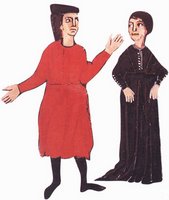 found a group of students – including Walchelin - and with an unexpectedly heavy hand, killed several of them. After attempting to do what he could for his bloodied Compatriots, which was sadly very little, Walchelin eventually fled the retribution of the guard and made his way back to the University and his Parens to continue his studies and apprenticeship.
The strike and the results for Walchelin
Unfortunately, the response from the University was immediately to go on strike. Classes closed and striking students either went to other universities such as Rheims, Oxford or Toulouse, or returned home or found employment elsewhere. Faculty ceased to teach. Walchelin finally completed his apprenticeship and on the suggestion of his Parens and a newly discovered friend, he decided to head towards Provencal to seek a home, perform, fulfill his Redcap duties and possibly learn from any Troubadours that survived the Crusade.
The role of Euphêmía
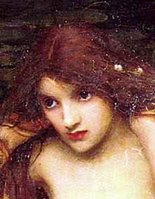 On the night of the riot, during a break in his performance at Les Yeux d'Émeraude, a beautiful young woman, by the name of Euphêmía, befriended Walchelin. With her striking green eyes, he was immediately attracted to her and he performed to the best of his abilities, attempting to engage her with a passionate performance. During the ensuing songs, he performed the full spectrum of his repertoire, including a beautiful and original tale of Hades and Perspehone, which referenced the unmatched work of Ovid – it was especially successful in the satirical targeting of Hades in-ability to control his stolen wife Persephone – a tale Walchelin himself made up. The performance, ultimately unfortunately, attracted some unexpected attention from a quarter that Walchelin has yet to realise – Hades himself, who did not appreciate the satire. Additionally the performance had a substantial impact on all of his audience who, rather than become friendly and happy towards each other became rather unfriendly, and extraordinarily passionate in their unfriendliness – not only those in the audience but Hades himself had quite an adverse reaction. Unknown to Walchelin a well-intentioned member of his audience had botched her intervention in the events of the night. During his performance the young woman he had met led a dance amongst a number of the crowd but unknown to her this dance had not only failed but gone completely awry having the reverse of her intention of friendliness amongst all who heard the performance, instead unfriendliness, leading ultimately to fisticuffs and bloodshed ensued over the following days.
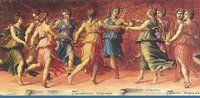
Nevertheless, the magnificent performance of the Troubadour Walchelin won the undying adoration of Euphêmía who proceeded to spend much time with the young Walchelin, arriving at all his performances and taking part in many dances with the crowds who attended. Eventually she revealed her true form of a Fae Muse to Walchelin – who had already guessed – after she collapsed minutes after a particularly long and frenetic performance and accompanying dance. Euphêmía is now accompanying him south to continue her dancing, carousing and enjoyment of Walchelin’s art. For his part Walchelin appreciates the beauty and dance of Euphêmía and her ability to exhort the crowd, he suspects that she enhances his Music through her own performances, but little suspects that her dancing is Faerie Folk Dancing that requires another to be performing in order for it to succeed in having any effect.
The Curse of Hades
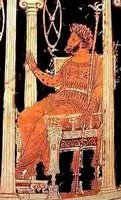 Unfortunately, Hades took great umbrage at the young Troubadour’s performance and he is biding his time to exact revenge. Hade’s plan is that when the Troubadour finds himself truly in love the Faerie God has decided that he will steal the object of the Troubadour’s affections away to Hades. As he has done with a number of young loves in the past, and then, at every opportunity, Hades will taunt the forlorn Minstrel with his powerlessness in the face of the Fae God.
Beliefs and Patron Saints
Walchelin is a firm believer in the Divine and tries to be a good Christian. He venerates Saint Cecilia, patron Saint of Musicians and Poets, for the beauty she has brought to the world in offering song and music in praise of the Divine and the protection she offers to those who continue to perform and compose music and poetry. Walchelin has been considering a pilgrimage to her Church in Rome in the hope of being able to perform in her honour on her Holy Feast Day on 22 November. He annually celebrates her feast day to as large an audience as he can muster. He also venerates Saint Christopher, patron Saint of Travelers, Bachelors and Storms, for his compassion and aid to travelers. Walchelin always celebrates Saint Christopher’s Feast Day on 25 July with a performance for the Saint, even when on the road pursuing Redcap duties and finding himself without an audience. He sees both these Holy figures as inspiration for his own actions as he moves through the world helping others by working for the Order of Hermes and composing and performing to bring joy to audiences.
Music Style and Genre
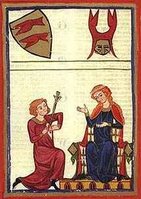
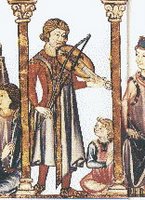 Walchelin prefers a style of playing and singing that consists of rich dialogue varied by refrains, the melodies to which have the character of folk music, and are spontaneous and tuneful but overlay elaborate and complex compositions that are harmonious. Normally he performs trobar ric, though increasingly trobar leu has exerted influence over his music. Very rarely Walchelin plays the more restrictive trobar clus. When playing, two of his favourite genres are Descort and Tenso; though he finds the combination of challenge and foolishness that is the Sestina occasionally driving him to attempt this more difficult genre. He prefers to play the Mandolin but is also skilled with other stringed instruments, as well as wind – such as the Bagpipes - and percussion – particularly the Tabor.
Styles
Trobar leu
The trobar leu, or light style of poetry, was the most popular style used by the troubadours. Its accessibility gave it a wide audience.
Trobar ric
Distinguished by its verbal gymnastics trobar ric, or rich form of poetry, has always played a secondary role to trobar leu.
Trobar clus
Only an elite few truly appreciate Trobar clus, or closed form, troubadours for their more discerning audiences’ use this style of poetry. Marcabru developed it extensively, but by 1200, its inaccessibility is leading to its disappearance.
Genres
The poetry of the troubadour songs covered many topics, from the profound to the humorous and from war at home to the crusades. However, they are best known for expounding on the theme of fin' amors, or courtly love.
· Alba: The Alba is a song of the morning, used by the troubadours. It concerns the departure of a lover in the early morning.
· Coblas: This poem or song is composed of several strophes, each a pair of stanza of alternating forms. A band is also a Coblas.
· Descort: The Descort is a song of disagreement used by the troubadours. The subject matter is one of disagreement and this is emphasised by unusual metric structures and irregular rhymes.
· Devinaill: No clue on what this Genre is about.
· Estampida: The Estampida is the Occitan equivalent of the French Estampie. The Estampie is a melody without words with a complicated melodic progression. This does not seem to have been a universally accepted definition however; the song Kalenda Maia by court troubadour Raimbaut de Vaqueiras describes itself as an Estampida.
· Pastorela: The Pastorela is a poetic genre used by the troubadours. It concerns the meeting of a knight with a Shepherdess, which may lead to any of a number of possible conclusions. They are usually humorous pieces.
· Planh: The Planh is a funeral lament used by the troubadours, modeled on the Medieval Latin Planctus. It differed from the Planctus in that it is performed for a secular audience.
· Retroencha: This is a classical song of praise.
· Sestina: Of all the poetic forms, the sestina is perhaps the silliest. The troubadour Arnot Daniel almost certainly invented it and had the good sense to write only one. Created using six key words, the sestina has six stanzas of six lines each with a concluding three-line stanza at the end. The six key words appear at the end of one line each in the first stanza, and we shall call the order they occur in 1, 2, 3, 4, 5, 6. In the second stanza, each line again is concluded with a key word, this time in order 6, 1, 5, 2, 4, 3. In the third stanza the words are shuffled the same way, so that the order is 3, 6, 4, 1, 2, 5. This continues until six stanzas have been completed. The six words are then used in the concluding three-line stanza, with two key words per line.
· Sirventes: a satirical poem devised to a melody.
· Tenso: A Tenso is a song style favoured by the troubadours. It takes the form of a debate in which each voice defends a position on a topic relating to love or ethics.